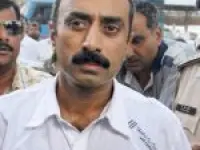
‘Eight Years of Unjust Incarceration’: Sanjiv Bhatt’s Family Marks 2,923 Days Of Imprisonment As Children Vow Never To Yield
Marking eight years since the former Indian Police Service (IPS) officer and a critic of PM Modi, Sanjiv Bhatt, was taken from his home by law enforcement authorities, his children, Aakashi Bhatt and Shantanu Bhatt, have released a powerful joint statement condemning what they describe as “2,923 days of unjust incarceration”.
Recalling the morning of 5 September 2018—when officers entered their family home and arrested Mr Bhatt under the “guise of trumped-up charges manufactured to silence his voice of truth”—his family declared that despite eight years of separation, their resolve to fight the state machinery remains entirely unbroken.
“Today, 5th September, marks 8 years since this regime came into our home and took our father from us, tearing our family apart,” wrote Aakashi and Shantanu Bhatt.
“Eight years is an extraordinary amount of time to measure the life of a family, but there are moments when time becomes a strange and almost meaningless measure… our hearts and souls remain rooted in that September morning when our world was turned upside down.”
Reflecting upon their father’s career and his decision to challenge the state’s highest political figures, the statement highlighted the personal cost of refusing to compromise one’s conscience:
“Not simply a name that appears in newspapers, nor the IPS officer who has become a symbol of something much larger, but our father, a man who possesses the extraordinary strength and resilience to keep fighting a battle he knew would cost him everything… He fought for people who had suffered hate and violence for the political ambition of one man. He raised his voice when remaining silent would have been infinitely easier.”
Warning of the systemic collapse of democratic institutions, the children cautioned that Mr Bhatt’s protracted ordeal serves as a stark precedent for broader societal repression:
“The greatest victory of repression is not breaking the person it targets, but convincing everyone watching that there is nothing they can do! Democracy does not disappear in a single dramatic moment. Its foundations are eroded far more quietly when institutions that were created to restrain power begin serving it… when truth becomes inconvenient and therefore dangerous; and, perhaps most dangerous of all, when ordinary citizens decide that it is safer to look away.”
Reaffirming their commitment to challenge his ongoing detention, the siblings concluded with an unyielding pledge:
“Eight years have passed since they tried to silence our father’s voice of truth. Eight years since they stole his freedom, but failed to shake his courage… Our fight for justice continues! We may be bloodied, battered and bruised… but we remain unbroken, unbent, unbowed!”
Sanjiv Bhatt, a 1988-batch IPS officer of the Gujarat cadre, emerged as one of the most prominent internal whistleblowers in India after filing an affidavit in the Supreme Court in April 2011. In his affidavit, Mr Bhatt alleged that he had attended a high-level meeting on the night of 27 February 2002 hosted by the then Chief Minister of Gujarat, Narendra Modi, following the Godhra train burning. He alleged that political instructions were given to allow Hindu rioters to vent their anger against the Muslim community during the subsequent 2002 Gujarat riots.
His allegations were later disputed by the Supreme Court-appointed Special Investigation Team (SIT), which stated Mr Bhatt was not present at the meeting. Following his public disclosures, Mr Bhatt faced a barrage of disciplinary actions, culminating in his suspension from the IPS in 2011 and ultimate dismissal from service in 2015 on grounds of “unauthorised absence”.
On 5 September 2018, the Gujarat Police CID arrested Sanjiv Bhatt from his residence. The initial ground for his arrest was a 22-year-old narcotics case dating back to 1996, in which he was accused of falsely implicating a Rajasthan-based lawyer by allegedly planting drugs in a hotel room in Palanpur, where Bhatt had served as District Superintendent of Police.
While detained under trial in the drug case, the legal pressures against him mounted rapidly:
1990 Custodial Death Conviction: In June 2019, a Sessions Court in Jamnagar convicted Mr Bhatt and sentenced him to life imprisonment regarding a 1990 custodial death case. The incident stemmed from the detention of around 150 people during a communal clash in Jamjodhpur. One detainee, Prabhudas Vaishnani, died of kidney failure shortly after his release, with his family alleging he had suffered custodial torture. Mr Bhatt’s legal team argued that the detainee was never in his physical custody and that the prosecution was revived decades later as part of a political vendetta.
1996 Drug Planting Case Conviction: In March 2024, a trial court sentenced Mr Bhatt to 20 years of imprisonment in the 1996 narcotics case.
2002 Riots Conspiracy Case: In July 2022, Gujarat Police’s Special Investigation Team formally arrested Mr Bhatt alongside activist Teesta Setalvad and former DGP R.B. Sreekumar, accusing them of fabricating evidence to implicate high-ranking officials in the 2002 riots.
Throughout his eight years behind bars, higher courts—including the Gujarat High Court and the Supreme Court of India—have repeatedly rejected his applications for bail and suspension of sentence.