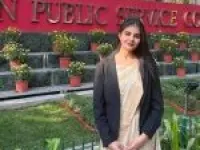
UPSC CSE 109 Rank: How Kozhikode’s Ajay Raj Defied The Odds To Conquer The Civil Services
Kozhikode: Ajay R Raj, a visually impaired academic from the small town of Thottilpalam in Kozhikode, has achieved what many deemed impossible: securing a coveted spot in the UPSC Civil Services Examination. His journey, marked by years of quiet perseverance and a refuse-to-quit attitude, serves as a spectacular reminder that disability is never a barrier to brilliance.
The results of the 2025 examinations tell a story of remarkable progression. While last year saw Ajay secure the 730th rank—an achievement that drew praise from many including Kerala’s Higher Education Minister, Dr R. Bindu—his determination did not end there. In the most recent results, Ajay has surged forward to claim an extraordinary 109th rank, firmly establishing his place amongst the country’s future administrative elite.
A Journey of Academic Rigour
Ajay’s path to the civil services was paved with academic excellence. A former national-level topper in the CBSE Plus Two examinations, he moved from the Malayalam-medium schools of his village to the prestigious St. Stephen’s College in Delhi. It was here, amongst the best minds in the country, that his ambition for public service began to crystallise.
Despite his partial visual impairment caused by a nerve disorder, Ajay refused to seek shortcuts. “I think the doubt only ends when you see your name on the rank list,” he reflected in an interview. “Until then, it is a journey riddled with uncertainty. There were countless moments I doubted myself, but I had a support system that helped me see clearly when I couldn’t.”
Strategy and Support
Securing his position in the civil services on his fifth attempt, Ajay reflected on a journey of evolving dedication. He admitted that his initial two forays were less focused, but he significantly intensified his efforts and commitment during the final three sittings.
Attributing much of his success to structured discipline, Ajay shared: “I adhered strictly to the schedule provided by my coaching academy, ensuring I sat for every mock exam and followed their guidance to the letter. Joining the IAS has always been my primary ambition. While this is a personal milestone, the happiness at home is immense; this achievement belongs as much to the people who supported me as it does to my own hard work.”
Interestingly, Ajay noted that he never looked to a single role model, choosing instead to live by a singular, steadfast principle: relentless persistence. “Work hard toward your goal. If you fail, simply try again,” he explained. He identified his brother as his most vital guide and source of support, alongside a circle of inspiring friends.
Ajay also highlighted how his previous tenure as a college lecturer proved invaluable during the UPSC interview stage. Rather than a rigid question-and-answer session, he described the encounter as an opportunity to project his true character. Speaking to Asianet News, he noted, “The interview is about exposing your personality. The board members were exceptionally friendly, which helped in making it a constructive dialogue.”
Success in the UPSC, often described as India’s toughest examination, requires more than just intelligence; it requires a strategy. Ajay initially chose Malayalam literature as his optional subject but eventually pivoted to Sociology, a move he credits to his interdisciplinary background in English literature. He sought mentorship from experts in Chennai and Trivandrum, learning to “unlearn” his purely analytical academic habits to meet the factual rigour demanded by the UPSC prelims.
Behind his individual brilliance was a dedicated “team Ajay.” From his flatmate, who stayed up late into the night reviewing his answers, to his parents—his father, an autorickshaw driver, and his mother, a homemaker—every person in his life played a role. His brother, who faces similar visual challenges and is pursuing a PhD at JNU, served as a constant source of inspiration.
A Grounded Message for Aspirants
Perhaps most striking is Ajay’s pragmatic approach to the exam. While the system often lionises “blind perseverance,” Ajay advocates for a “Plan B.” He maintains that while the Civil Services are prestigious, they are not the “end of the world.”
“We should be realistic,” he advised in a an earlier interview with Timeline. “Success has many fathers, but failure is orphaned. If it doesn’t work out after a few committed attempts, move on. UPSC is one opportunity, not your entire life.”
For Ajay, the civil service is a “larger canvas” upon which he hopes to paint a more inclusive future for India. Having experienced the limitations of rural infrastructure for the differently-abled, he aims to use his new platform to ensure that mainstream society is accessible to everyone, regardless of physical limitations.
As he prepares to swap the lecture hall for the halls of government, Ajay R. Raj stands as a beacon of hope. His story is not just one of overcoming disability, but of the relentless pursuit of excellence that remains undimmed by the “unseen horizons.”